
Writing in Japanese --- How Does It Work?
In English we have only one system for writing: the Roman alphabet. Many other languages use the Roman alphabet, too, with a few modifications. For example, the French language puts accents on some letters:
Russian uses its own alphabet. Here are a few words in Russian:
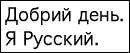
Although the Russian words look strange, the letters are phonetic symbols, just like our Roman ones.
Unlike English and Russian, Japanese has three systems used for writing. One system, called kanji, is derived from Chinese characters. Each symbol represents an idea, as opposed to representing a sound.
For example, the following kanji means water:

One must memorize how the corresponding word is pronounced. In Japanese, when this character appears by itself, it is pronounced "mizu". When it is grouped with another kanji, to form a different word, it is pronounced "sui".
There are thousands of kanji in the Japanese language. The average Japanese adult knows about 1800 kanji. This is sufficient for everyday life.
If you are thinking of learning Japanese, don't despair. You do not have to learn all of those kanji right away. There is a phonetic writing system that can be used for writing Japanese words. It is called hiragana.
Hiragana is a set of about 60 characters, each of which represents a spoken syllable. Here are a few examples:
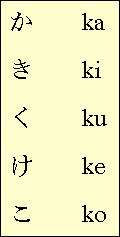
Japanese words are made up of syllables, without contiguous consonants. It takes a bit of getting used to writing in hiragana, but with practice, it can be mastered in a reasonable amount of time. Like Japanese children, foreigners learning Japanese begin with hiragana. They graduate to kanji once they have mastered hiragana and have a basic ability to communicate in Japanese. In adult texts, hiragana are attached to kanji as suffixes and grammatical endings, like verb tenses. They are also used for Japanese words for which there exists no kanji.
Too much, you say? We are not finished! There is yet another system of writing which must be learned! It is called katakana. Like hiragana, katakana consists of a set of characters, each of which represents a syllable. They are used for writing words of foreign origin or foreign names. Katakana are also used for words like "BOOM!" and "ZAP!" in comics, etc.
Here is an example of katakana, for the same syllables as the hiragana above:
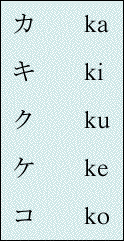
As you can see, some katakana characters are similar to their hiragana counterparts. Others are completely different.
In ordinary Japanese text all three types of characters are used. For example, consider the following sentence:
I am a Canadian.
Here it is in Japanese, written in Roman letters beneath:
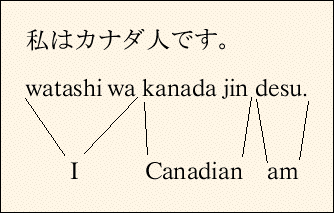
When you begin to learn how to write in Japanese, it is easy to ask, "How did I get myself into this mess?" But as you continue, and choose to invest the time, it becomes one of the most fascinating things that one can study.
It becomes an adventure of discovery. In my studies of written Japanese I have become acquainted with Japanese culture and the Japanese way of viewing the world. This discovery helps me to better understand my own Western point of view and mentality.
If you would like to learn more about written Japanese, take a look at the following web sites:
http://www.amy.hi-ho.ne.jp/masashi/english/japan.html
http://members.aol.com/writejapan/hiragana/kana.htm
In closing, there is one very important thing to do while learning Japanese:
Have fun!
Sayonara,
Jeff Brower
Back to Happano Top page