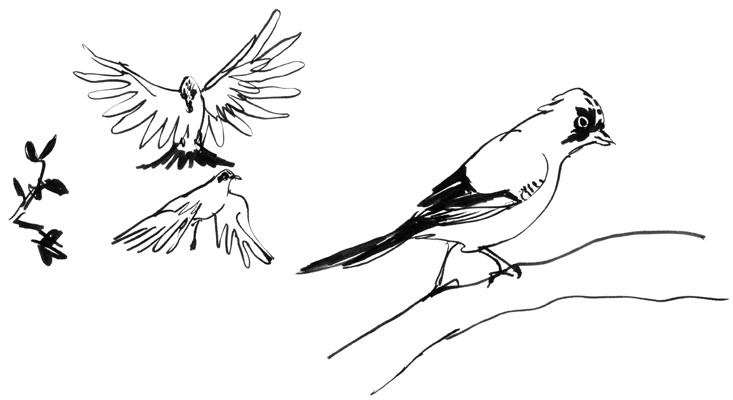
There is always more life abroad in the winter hills than one looks to find, and much more in evidence than in summer weather. Light feet of hare that make no print on the forest litter leave a wondrously plain track in the snow. We used to look and look at the beginning of winter for the birds to come down from the pine lands; looked in the orchard and stubble; looked north and south on the mesa for their migratory passing, and wondered that they never came. Busy little grosbeaks picked about the kitchen doors, and woodpeckers tapped the eaves of the farm buildings, but we saw hardly any other of the frequenters of the summer canons. After a while when we grew bold to tempt the snow borders we found them in the street of the mountains. In the thick pine woods where the overlapping boughs hung with snow-wreaths make wind-proof shelter tents, in a very community of dwelling, winter the bird-folk who get their living from the persisting cones and the larvae harboring bark. Ground inhabiting species seek the dim snow chambers of the chaparral. Consider how it must be in a hill-slope overgrown with stout-twigged, partly evergreen shrubs, more than man high, and as thick as a hedge. Not all the canon's sifting of snow can fill the intricate spaces of the hill tangles. Here and there an overhanging rock, or a stiff arch of buckthorn, makes an opening to communicating rooms and runways deep under the snow.
The light filtering through the snow walls is blue and ghostly, but serves to show seeds of shrubs and grass, and berries, and the wind-built walls are warm against the wind. It seems that live plants, especially if they are evergreen and growing, give off heat; the snow wall melts earliest from within and hollows to thinnness before there is a hint of spring in the air. But you think of these things afterward. Up in the street it has the effect of being done consciously; the buckthorns lean to each other and the drift to them, the little birds run in and out of their appointed ways with the greatest cheerfulness. They give almost no tokens of distress, and even if the winter tries them too much you are not to pity them. You of the house habit can hardly understand the sense of the hills. No doubt the labor of being comfortable gives you an exaggerated opinion of yourself, an exaggerated pain to be set aside. Whether the wild things understand it or not they adapt themselves to its processes with the greater ease. The business that goes on in the street of the mountain is tremendous, world-formative. Here go birds, squirrels, and red deer, children crying small wares and playing in the street, but they do not obstruct its affairs. Summer is their holiday; "Come now," says the lord of the street, "I have need of a great work and no more playing." But they are left borders and breathing-space out of pure kindness. They are not pushed out except by the exigencies of the nobler plan which they accept with a dignity the rest of us have not yet learned.
# Contents